





























A Comprehensive Guide to Bill of Lading Knowledge
Basic Knowledge and Key Points
1. A Bill of Lading is typically issued as 3 originals and 3 copies, though sometimes 2 originals and 3 copies. If the letter of credit has specific requirements, be sure to communicate this clearly to the freight forwarder.
For T/T payment terms, theoretically only one original bill of lading is needed (once cargo is released, the other originals automatically become void; copies cannot be used to take delivery). After receiving full payment via T/T, you may consider keeping one original for yourself and sending all remaining originals to the customer (to guard against loss of the bill of lading during courier transit).
2. The carrier (full name) must appear on the front of the bill of lading. This is what I have learned. In practice, when handling a letter of credit, the bank informed me that the documents were safely presented and payment was received even though the carrier was not shown on the bill of lading (so theoretically, it should be displayed).
If the carrier is shown on the front, the carrier company stamps and signs directly in the lower right corner.
If the carrier is not shown on the front and the bill of lading is signed by a freight forwarder, the signatory’s capacity must be indicated when signing.
If the carrier’s full name is shown on the front but the bill of lading is signed by a freight forwarder, the forwarder’s capacity must be indicated when signing.
3. Shipped on board bill of lading vs. received for shipment bill of lading:
Shipped on board bill of lading: issued after the goods have been loaded on board the vessel.
Received for shipment bill of lading: issued before the goods are loaded, merely indicating that the carrier has taken custody of the goods delivered by the shipper. Therefore, this bill of lading cannot prove the time of shipment (the date on a received for shipment bill of lading is not the on-board date).
4. The bill of lading must not contain any unclean notations.
5. The consignee and notify party on the bill of lading must be completed strictly in accordance with the letter of credit.
6. Issuance, Date and Number of Copies of the Bill of Lading: The Bill of Lading must be issued by the carrier, the master, or their agent, and the identity of the issuer must be clearly indicated. Common expressions include: CARRIER, CAPTAIN, or “AS AGENT FOR THE CARRIER: XXX”, etc.
7. For Bills of Lading pre-printed with the shipping line’s (carrier’s) name, the freight forwarder will usually add “as agent for the carrier”. If the shipping line’s name is not pre-printed on the Bill of Lading, it must bear the shipping line’s stamp and signature (your shipment should be covered by a carrier-signed shipping line Bill of Lading).
8. Discrepancies Related to the Bill of Lading under a Letter of Credit: The carrier is not indicated on the Bill of Lading. Upon checking, the official interpretation is as follows: According to Article 23, Paragraph 1 of the Uniform Customs and Practice for Documentary Credits (UCP), a marine Bill of Lading must indicate the name of the carrier on its face and be signed or otherwise authenticated by the carrier or a named agent for or on behalf of the carrier, or by the master or a named agent for or on behalf of the master.

Chronological Order of Document Preparation under L/C Payment Terms
Bill of Lading Classification
Bills of lading are divided into the following three types:
First, a Straight Bill of Lading, which specifies the name of the consignee. China's Maritime Law stipulates that a straight bill of lading is non-negotiable, and the carrier must deliver the goods to the consignee named on the bill.
Straight bills of lading are not widely used in international maritime trade and are generally only used for shipping personal effects or exhibition goods. (For the first TT transaction, the consignee was directly the customer's name, without realizing the potential danger: never issue a straight bill of lading without guaranteed payment collection.)
Therefore, one must not only remember the non-negotiable nature of a straight bill of lading, but also remember that "the consignee of a straight bill of lading can take delivery without presenting the original bill, so the bill effectively loses its function as a document of title." This is a crucial point! A comprehensive understanding of the concept is essential to avoid errors and losses at work. Therefore, if you only receive a 30% deposit with the remaining 70% payable by T/T after shipment, and you issue a bill of lading made out to a named consignee (i.e., a straight bill of lading), you risk losing both the payment and the goods if the customer has poor credit and fails to pay. Of course, if you have full confidence in the customer and are assured of payment, it is a different matter.
Second, a Bearer Bill of Lading (Open B/L or Blank B/L), where the consignee field is left blank. This type of bill is transferable without endorsement, and the carrier delivers the goods against surrender of the original bill.
A bearer bill of lading does not specify the name of the consignee. Whoever holds the bill of lading may take delivery of the goods from the carrier by presenting the bill. The carrier delivers the goods against the document, not against a specific person.
The consignee field on the bill of lading is marked: To the order
3. Order bill of lading, i.e., a bill of lading under which the goods are delivered according to the instructions of the party named on the bill. This is the type of bill of lading commonly used in current international trade.
1. To the order of the bank. The consignee field on the bill of lading is filled in as “to the order of xx Bank”.
2. To the order of the consignee. The consignee field on the bill of lading is filled in as “to the order of A.B.C. Co. Ltd”.
3. To the order of the shipper. The consignee field on the bill of lading is filled in as “to the order of shipper”, and the shipper endorses the bill in blank on the reverse side. This type of bill of lading may also be endorsed to a named party as required by the letter of credit. The shipper may also choose not to endorse it, in which case only the shipper can take delivery of the goods, meaning the seller retains title to the goods.
The so-called delivery of goods without presentation of the original bill of lading refers to the act of the carrier delivering the goods without receiving the original bill of lading.
At present, for order bills of lading and bearer bills of lading, the carrier must deliver the goods against the original bill of lading. If the carrier delivers the goods without the original bill of lading, regardless of to whom the goods are delivered, the lawful holder of the original bill of lading may hold the carrier liable for breach of contract for delivery without presentation of the original bill. This is uniformly upheld in China’s maritime judicial practice. However, in the case of a straight bill of lading, if the carrier delivers the goods to the named consignee without the original bill of lading, can the lawful holder of the straight bill of lading claim against the carrier for breach of contract? Currently, there is a tendency towards a negative answer in both theory and practice.
Bill of Lading Release Methods
4. Remote Release: Subject to shipping line approval.
Container Loading Options
2. CFS (Container Freight Station) Loading: The factory delivers the cargo directly to the freight forwarder's warehouse, where it is then transported into the port area on your behalf. The cargo owner is not authorized to deliver directly into the port area.
The Notify Party on the Bill of Lading Should Not Be Underestimated
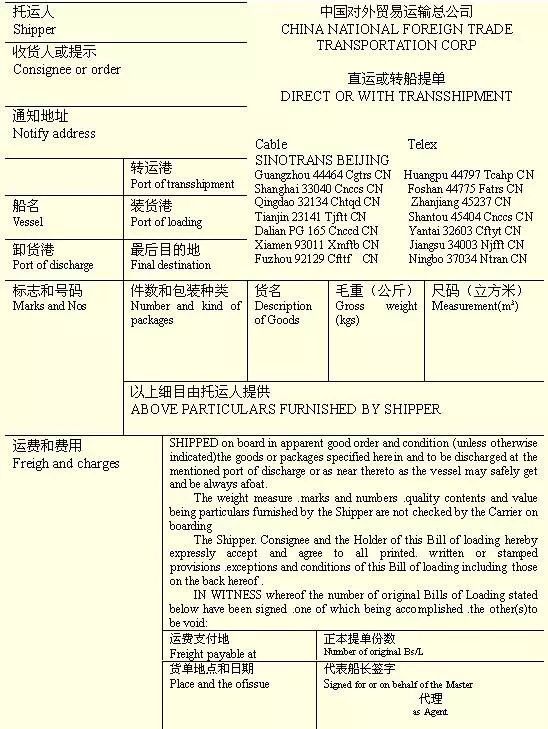
On an ocean bill of lading, there is a party that is often overlooked, yet its importance should not be underestimated—the Notify Party. Typically, the destination port information section on a bill of lading requires two or even three companies to be listed, usually the Consignee and the Notify Party. Some shipping lines' bills of lading also include a First Notify Party and a Second Notify Party.
Distinguishing Between Consignee and Notify Party
The Consignee refers to the receiver of the goods, typically the customer at the destination port, i.e., the actual buyer. Under letter of credit payment terms, it is usually a bank.
The Notify Party refers to the contact party for the destination port customer. If the customer is to be contacted directly, it can be filled in as "Same as consignee"; otherwise, it generally indicates the customer's agent or trader at the destination port.
The Purpose of the Notify Party
Upon the cargo's arrival at the destination port, the shipping company will promptly notify the Notify Party of the arrival information, facilitating the Notify Party to inform the Consignee to take delivery or make other arrangements. This helps prevent delays in picking up the goods, which could lead to demurrage and detention charges or even substantial penalties. Therefore, to ensure notification is received, there are sometimes two Notify Parties. Under letter of credit payment terms, the Consignee on the bill of lading is often the issuing bank, not the actual receiver; when all documents are presented to the issuing bank, the bank will notify the actual buyer to proceed with negotiation and other processes.
In many cases, the notify party is unaware or has not been communicated with in advance, resulting in the arrival notice not reaching the consignee in time, which leads to delays in cargo pickup and additional costs. Therefore, when confirming the bill of lading, special attention must be paid to the notify party field—it should not be filled in casually.
About "To Order"
Sometimes we encounter "To order" bills of lading. A "To order" B/L generally refers to an order bill of lading. The typical format is "To order of xxx," which requires endorsement by "xxx" for transfer or cargo release. If the consignee field on the B/L only states "To order," it means "To order of shipper," requiring the shipper's endorsement. The notify party only serves to inform the consignee and is not related to the endorsement.
Questions About the Notify Party
Generally, the consignee is notified. On most bills of lading, the notify party's information serves as the primary contact details for the destination port agent to reach the consignee. This is because the consignee on many B/Ls is "To order" and not directly named. Sometimes, if the notify party cannot be reached, the agent will contact the consignee, or if necessary, the shipper.
The consignee. Whether it is an original or telex release, it represents the transfer of title, and fundamentally it must be transferred to the title holder. The party that truly holds the title to the goods is the consignee.
On the surface, this seems convenient as it allows transfer to any consignee. However, in practice, most shipping lines stipulate that the consignee and notify party cannot both be "To order." Only one can be designated as such, which is a measure to mitigate freight risks.
Some shipping lines' bills of lading provide for a first notify party and a second notify party. If not, you can list both companies under one notify party entry.
No. When the consignee on the original bill of lading issued by the shipping line is "To order," and the shipper does not endorse it before sending it to the customer, the consignee cannot take delivery, let alone the notify party.
It is best not to use "To order." After all, the purpose of the notify party is to stay informed of the cargo's arrival status and notify the consignee to take delivery in a timely manner. If there is no specific notify party, you can generally enter "Same as consignee."
If the consignee is "To Order", a Notify Party with specific contact details must be provided. Otherwise, upon vessel arrival, the inability to notify the importer or responsible party may prevent cargo release and could even lead to serious consequences such as customs confiscation. If AMS/ACI filing is required, it may also result in substantial fines imposed by the destination customs.
9)The cargo has arrived, and the client says the Notify Party's name is incomplete, requesting an amendment, otherwise customs clearance cannot proceed. Does this really have an impact?
Frequently Asked Questions
1. Why can overseas buyers sometimes take delivery without a bill of lading?

In theory, a bill of lading serves as a "document of title," meaning whoever lawfully holds the bill of lading is entitled to take possession of the goods.
A bill of lading involves four parties: the Shipper (exporter), the Carrier (freight forwarder/shipping line), the Consignee, and the Notify Party. The "Consignee" field determines who is entitled to the goods.
2. Which countries allow taking delivery without the original straight bill of lading?
Currently, there are two main legal systems in the world: common law and civil law. Under common law, it was historically held that a straight bill of lading is not a document of title. Therefore, countries following the common law system are more prone to instances where goods are released without authorization under a straight bill of lading.
Common law countries include:
United States, Canada, United Kingdom, Australia, Hong Kong, New Zealand, India, Pakistan, Bangladesh, Malaysia, Singapore, Bahamas, Botswana, Brunei, Cameroon, Cyprus, Fiji, Gambia, Ghana, Grenada, Guyana, Jamaica, Kenya, Kiribati, Lesotho, Maldives, Malta, Mauritius, Mozambique, Namibia, Nauru, Nigeria, Seychelles, Sierra Leone, South Africa, Sri Lanka, Eswatini, Tanzania, Tonga, Trinidad and Tobago, Tuvalu, Uganda, etc.
When in doubt, you can check online whether the foreign party belongs to a common law jurisdiction.
However, even in common law countries (including the UK), some precedents have emerged in recent years recognizing a straight bill of lading as a document of title. In common law systems, precedents are law, which can be seen as a turning point. Even so, caution is still necessary—prevention is the priority. If something goes wrong, even if you win the lawsuit, it is often not worth the cost for the vast majority of small and medium-sized export enterprises. Moreover, winning is not guaranteed; experienced foreign parties can easily turn litigation into a commercial dispute, dragging on for years.
3. Are a Freight Forwarder’s Bill of Lading and a Master Bill of Lading the Same?
In practice, we encounter two types of bills of lading: the master bill of lading (MBL) and the house bill of lading (HBL). A shipping line is a freight company that owns ocean-going vessels. An ocean-going vessel costs a fortune to build, so companies with their own fleets are naturally well-capitalized. In a sense, such companies are also more reliable, as they value their reputation in long-term business and will not risk it for small gains, making their operations relatively more standardized. The other type of freight company is the freight forwarder. Forwarders do not own ships; in a sense, they are similar to ordinary trading companies. They consolidate cargo and then book space with the shipping lines. We can think of the relationship between shipping lines and forwarders as that of wholesalers and retailers, with the "commodity" being the space on ocean-going vessels. Shipping lines wholesale space to forwarders, and forwarders retail that space to us.
It is easy to imagine that while shipping lines are reliable, they can be somewhat overbearing due to their size, often falling short of forwarders in terms of service flexibility and attentiveness. Forwarders are numerous and widely distributed, making communication with us in foreign trade very convenient, and they are generally more willing to accommodate our operational needs, especially for special arrangements like the "antedated bill of lading" mentioned earlier. Therefore, in practice, we deal with forwarders more commonly.
On the surface, a master bill of lading and a house bill of lading appear to have similar validity: we sell the original bill to the foreign buyer, who takes delivery of the goods with it. In reality, however, there are differences. First, the bill of lading itself is a "contract of carriage." When the carrier issues the bill to us, it is as if a carriage contract has been signed. A master bill of lading is a contract between us and the shipping line, whereas a house bill of lading is not. We hand the goods to the forwarder, who then hands them to the shipping line. There is a carriage agreement between the forwarder and the shipping line, and the shipping line is only responsible to the forwarder, not to us as the cargo owner, because under a house bill of lading arrangement, the forwarder is considered the "cargo owner" from the shipping line's perspective.
1. The SHIPPER sends the shipping instruction to the FORWARDER, specifying whether it is an FCL or LCL shipment.
2. The FORWARDER books space with the shipping line. After the vessel is ON BOARD, the shipping line issues the MBL to the FORWARDER. The SHIPPER on the MBL is the FORWARDER at the port of origin, and the CNEE is generally the FORWARDER's branch or agent at the destination port.
3. The FORWARDER issues the HBL to the SHIPPER. The SHIPPER on the HBL is the actual cargo owner. The CNEE is usually made out TO ORDER for Letter of Credit transactions.
4. The CARRIER transports the goods to the destination port after the vessel sails.
5. The FORWARDER sends the MBL via DHL/UPS/TNT, etc., to its branch at the destination port. (INCLUDING: CUSTOMS CLEARANCE DOCS)
6. After receiving the Bill of Lading, the SHIPPER presents the documents to the domestic negotiating bank within the presentation period for settlement. If the transaction is T/T, the SHIPPER sends the documents directly to the overseas customer.
7. The negotiating bank presents the full set of documents to the issuing bank for settlement.
8. The consignee makes payment to the issuing bank to release the documents.
9. The forwarder presents the MBL to the shipping line to exchange for a delivery order, then handles customs clearance.
Source: Cangnayun
If there is any infringement, please contact us for removal.